HANSOH PHARMA PRESENTS POSITIVE PHASE II CLINICAL STUDY OF HS-10374, IN PATIENTS WITH MODERATE-TO-SEVERE PLAQUE PSORIASIS AT CDA 2024
SHANGHAI, November 29, 2024 — Hansoh Pharmaceutical Group Co., Ltd. (Hansoh Pharma, 03692.HK) today announced that the positive phase II clinical study data of HS-10374, an oral, selective, allosteric TYK2 inhibitor, in Patients with Moderate-to-Severe Plaque Psoriasis,is presented in a poster presentation at the 19th Annual Meeting of China Dermatologist Association & National Congress of Cosmetic Dermatology (CDA 2024) in Wuhan from November 28 to December 1.
The poster and viewing detail are listed below:
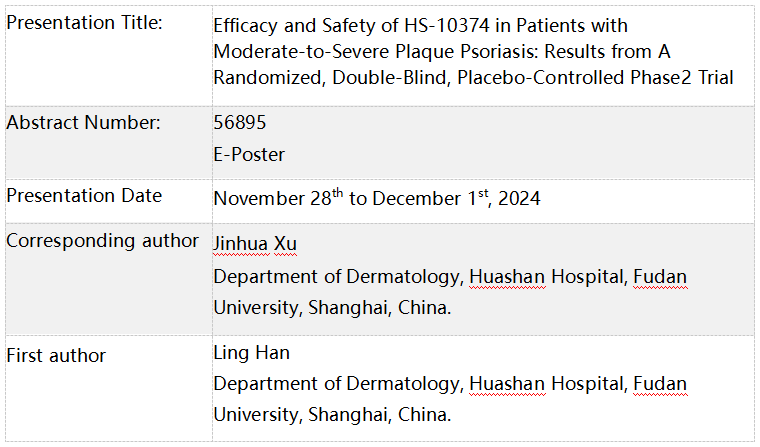
The presentation reports the Phase II clinical trial results. HS-10374 showed significant clinical efficacy versus Placebo (PBO) in terms of PASI 75 response rate and sPGA 0/1 response rate with oral doses of 6 mg QD or 12 mg QD in patients with moderate-to-severe plaque psoriasis. The overall safety profile was similar to other TYK2 inhibitors, as adverse events of“skin and subcutaneous disorders” in this study were more commonly reported in PBO group. Ongoing Phase 3 Trial (CTR20243822) with a longer treatment duration and larger populations will further confirm the efficacy and safety of HS-10374 (12mg QD)in such patients.
ABOUT Psoriasis
Psoriasis is a chronic, immune-mediated systemic disease characterized by recurrent inflammation. It is influenced by a combination of genetic predisposition and environmental triggers. The most prevalent form, plaque psoriasis, accounts for approximately 80%–90% of all cases. This condition presents as erythematous, scaly patches or plaques that can range from localized to extensive, affecting varying degrees of body surface area [1]. While psoriasis is not curable, it is a lifelong condition that significantly impacts patients' quality of life, work capacity, and, in severe cases, leads to disability. The disease imposes a substantial burden not only on patients but also on their families and society as a whole. Globally, psoriasis affects 0.14%–1.99% of the population [2]. In China, with a prevalence of 0.50%, an estimated 5 million individuals live with moderate-to-severe cases, highlighting the need for effective management and support [3, 4].
The recommended treatments for patients with moderate-to-severe psoriasis include systemic treatments and/or phototherapy [5]: traditional oral systemic treatments are selected less often for long-term safety concerns; phototherapy is time-consuming and inconvenient; biologics are highly effective, but not all patients respond in the same manner, and some patients have injection fear. There are still unmet medical needs for psoriasis patients, and new therapies should be developed.
References
[1] 中华医学会皮肤性病学分会银屑病专业委员会. 中国银屑病诊疗指南(2023版)[J]. 中华皮肤科杂志, 2023, 56(7): 573-625.
[2] Parisi R, Iskandar I, Kontopantelis E, et al. National, regional, and worldwide epidemiology of psoriasis: systematic analysis and modelling study[J]. BMJ, 2020, 369: m1590.
[3] 李慧贤, 胡丽, 郑焱, et al. 基于全球疾病负担(GBD)大数据的中国银屑病流行病学负担分析[J]. 中国皮肤性病学杂志, 2021,35(4):386-392.
[4] 胡煜,顾恒,陈崑.中国中重度银屑病疾病负担和未满足治疗需求的系统综述[J].中华皮肤科杂志,2023,56(10):965-972.
[5] April W, Armstrong, Charlotte, Read. Pathophysiology, Clinical Presentation, and Treatment of Psoriasis: A Review [J]. JAMA, 2020,323(19):1945-1960.
Hansoh Pharma is a leading innovation-driven pharmaceutical enterprise in China. With the mission of "continuous innovation for better life", the company focuses on major disease therapeutic areas such as oncology, metabolism, immunology, central nervous system (CNS) and anti-infectives. Hansoh Pharma has launched 7 innovative medicines that generate product sales in China, with the revenue from innovative medicines and collaborative products exceeding 80%, forming a rich product pipeline. The company has consistently ranked among the top 100 global pharmaceutical companies and is recognized as one of the top 3 pharmaceutical R&D enterprises in China, and is designated as a National Key High-Tech Enterprise and a National Technology Innovation Demonstration Enterprise. Hansoh Pharma was listed on the Hong Kong Stock Exchange in June 2019 (stock code: 03692.HK).
1. This announcement is intended for healthcare professionals only and not for advertising purposes.2. Hansoh Pharma does not recommend the use of any unapproved drugs or off-label indications, nor does it make recommendations regarding any drug or indication.3. The information provided in this announcement is for reference only; please follow the advice or guidance of a physician or other healthcare professional. Any treatment-related decisions made by healthcare professionals should be based on the specific circumstances of the patient and should be used in accordance with the instructions for the drug.4. For more detailed information about any company products, medical treatments, or diseases, please consult a healthcare professional.
Forward-Looking Statements
This press release is intended to provide information about Hansoh Pharmaceutical Group Co., Ltd. and its affiliates, including their subsidiaries (collectively referred to as "Hansoh Pharma"). It does not constitute a disclosure of information about Hansoh Pharma or any investment recommendations.The information contained in this release may include forward-looking statements related to Hansoh Pharma's business and product prospects, as well as its plans, beliefs, expectations, and strategies. These statements are predictions based on speculative assumptions and are not guarantees of future performance. They are subject to risks and uncertainties, such as scientific, commercial, political, economic, financial, legal factors as well as competitive environment and social conditions, many of which are beyond Hansoh Pharma's control and difficult to predict, thus actual results may differ significantly from what is stated here, and past securities price trends should not be used as a guide for future market conditions. As such, investors should exercise caution when using this information to make investment decisions. Phrases such as "commit," "expect," "believe," "predict," "anticipate," "forecast," "intent,"“project,” “may,” “will,” “should,” “plan,” “could,” “continue,” “target,” “contemplate,” “estimate,” “guidance,” “possible,” “potential,” “pursue,”“likely,”and words and terms of similar terms substance used in connection with any discussion of future plans, actions or events indicate forward-looking statements.Hansoh Pharma does not commit to or guarantee the accuracy, timeliness, or completeness of forward-looking information and assumes no obligation to update or revise these forward-looking statements. Neither Hansoh Pharma nor any of its directors, employees, or agents will be responsible for any forward-looking statements that prove to be inaccurate or unachievable and any losses or damages incurred by users due to reliance on the information provided herein, including but not limited to direct, incidental, indirect, or punitive damages.All information in this press release is current as of the date of release. Hansoh Pharma assumes no responsibility to update or revise this information in light of new developments, future events, or other circumstances, except as required by law. Additionally, Hansoh Pharma reserves the right to make changes, corrections, or discontinuations to all or part of the content of this press release at any time without notice. For information specifically related to the listed company, investors are encouraged to refer to the announcements and financial reports of Hansoh Pharma (03692.HK).