


- Resencatinib (HS-10365) has demonstrated encouraging and durable antitumor efficacy in patients with locally advanced or metastatic non-small cell lung cancer (NSCLC) harboring rearranged during transfection (RET) gene fusions[1].
- Resencatinib exhibits favorable tolerability and a manageable safety profile[1].
- Given its outstanding performance in efficacy and safety, resencatinib is expected to provide a novel treatment option for patients with locally advanced or metastatic NSCLC positive for RET gene fusions[1].
SHANGHAI, December 10, 2025 — Hansoh Pharmaceutical Group Co., Ltd. (Hansoh Pharma, 03692.HK) today announced that the encouraging results of resencatinib,a highly selective RET receptor tyrosine kinase inhibitor, for the treatment of locally advanced or metastatic non-small cell lung cancer (NSCLC) harboring RET gene fusions were presented in a poster session at the ESMO ASIA Congress 2025 (December 05-07, Singapore).
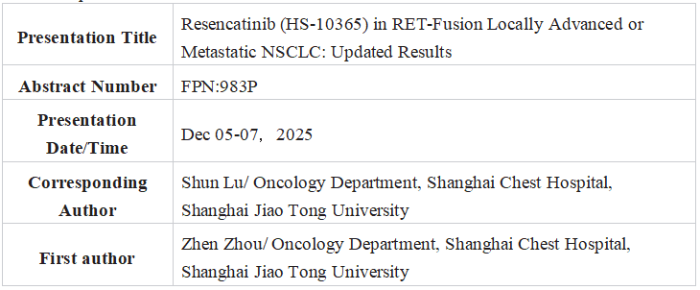
Details of the poster are as follows:
The HS-10365-101 study (NCT05207787) is a multicenter, open-label Phase Ⅰ/Ⅱ clinical trial designed as a "basket trial," aiming to evaluate the safety, tolerability, pharmacokinetic (PK) profile, and efficacy of orally administered resencatinib. Preliminary data from the Phase Ⅰ portion were previously presented at the 2023 American Association for Cancer Research (AACR) Annual Meeting. At this year’s ESMO ASIA Congress, updated results from the Phase II portion—with a larger sample size and longer follow-up duration—were released, further validating the clinical value of resencatinib in patients with locally advanced or metastatic NSCLC harboring RET fusions.
Study results showed:
Significant Efficacy: A total of 326 patients (data cutoff: Jan 18, 2025) with RET-altered advanced solid tumors were treated with resencatinib at 160mg twice daily (BID) orally in the Phase II study. Among them, 75 patients were in Cohort 1 (locally advanced or metastatic NSCLC harboring RET fusions who progressed after platinum-containing chemotherapy combined with or sequential to PD-[L]1 inhibitor therapy) and 60 patients in Cohort 2 (treatment-naive locally advanced or metastatic NSCLC harboring RET fusions). Efficacy results for Cohort 1 and Cohort 2 as assessed by the Independent Review Committee (IRC) are as follows: confirmed Objective Response Rate (ORR) was 80.0% and 83.3%, respectively; Disease Control Rate (DCR) was 96.0% and 93.3%, respectively; and 12-month Progression-Free Survival (PFS) rate was 81.1% and 79.3%, respectively.
Favorable Tolerability: During the study, the most common treatment-emergent adverse events (TEAEs) with resencatinib monotherapy were increased alanine aminotransferase (ALT; 64.7%), increased aspartate aminotransferase (AST; 64.1%), and decreased white blood cell (WBC) count (45.4%). The vast majority of TEAEs were controllable and manageable, with only 4.9% of patients discontinuing treatment due to TEAEs. No new safety signals were identified, further validating the safety of resencatinib for clinical application.
Conclusions: The study results demonstrate that resencatinib exhibits significant and sustainable antitumor efficacy, as well as favorable and manageable safety profile, in both treatment-naive and pretreated patients with locally advanced or metastatic NSCLC harboring RET fusions. It may provide another new treatment option for this patient population.
About resencatinib (HS-10365)
Resencatinib (HS-10365) is a Class 1 innovative drug independently developed by the Group. As a small-molecule, highly selective RET receptor tyrosine kinase inhibitor, it can act directly on intracellular protein tyrosine kinases, bind competitively with ATP, and inhibit tyrosine kinase phosphorylation, thereby effectively controlling tumor growth. Previously, the New Drug Application (NDA) for resencatinib was accepted by the National Medical Products Administration (NMPA) of China, for the treatment of adult patients with RET fusion-positive locally advanced or metastatic non-small cell lung cancer (NSCLC).
About NSCLC
Approximately 787,000 new lung cancer cases are diagnosed annually in China, among which RET fusion-positive patients account for 1% to 2% of all lung cancer cases — translating to around 11,000 new RET gene-positive lung cancer patients each year in the country[2-4]. Currently, there remains a significant unmet clinical need for specific RET-targeted therapies in China. Although several highly selective RET inhibitors have been recommended in clinical guidelines[5], additional novel treatment options are still required to further improve drug accessibility.
About ESMO Asia
ESMO Asia Congress 2025 will be held from December 5-7, 2025 in the Republic of Singapore. The congress serves as a vital platform to advance cancer care through the latest scientific discoveries, innovative therapies, and evolving clinical practices. Whether you’re a clinician, researcher, or healthcare provider, this gathering offers a front-row seat to the future of oncology.
References
1. Zhou Z, Wang Q, Wu L, et al. Resencatinib (HS-10365) in RET-fusion positive locally advanced or metastatic non-small cell lung cancer (NSCLC): Updated results [poster 983P]. Presented at: 2025 ESMO Asia Congress; December 5-7, 2025; Singapore.
2. Subbiah V, Yang D, Velcheti V, et al. State-of-the-Art Strategies for Targeting RET -Dependent Cancers. J Clin Oncol. 2020,38(11):1209-1221.
3. Zhang K, Chen H, Wang Y, et al. Clinical Characteristics and Molecular Patterns of RET-Rearranged Lung Cancer in Chinese Patients. Oncol Res. 2019, 27(5):575-582.
4. Zheng R S, Sun K X, Zhang S W, et al. Analysis of cancer incidence and mortality in China, 2015[J]. Chinese Journal of Oncology, 2019, 41(1):19-28.
5. Chinese Society of Clinical Oncology (CSCO). Guidelines for the Diagnosis and Treatment of Non-Small Cell Lung Cancer (2025).
About Hansoh Pharma
Statements
Forward-Looking Statements